Problem statement
Invator conducted a condition assessment of cylindrical concrete columns at Söderhallarna in Stockholm after extensive cracking was observed during a renovation project. The columns form part of the building’s load-bearing structure and consist of thin-walled precast concrete tubes with integrated ventilation shafts.

During the inspection, both vertical and horizontal cracks with widths of up to approximately 1 mm were noted, particularly in the upper floors where the concrete cross-section was reduced. To ensure continued load-bearing capacity and determine the cause of the damage, a combination of damage assessment, ground-penetrating radar survey, structural analysis, and design of reinforcement measures was required.
Outcome
GPR surveys and FE analyses showed that the cracking was structurally and load-induced. The analyses revealed good agreement between the simulated crack patterns and the damage observed on site. The cracking was primarily attributed to the columns’ thin-walled geometry, reduced wall thicknesses in the upper stories, and eccentric stresses from connecting steel beams and openings in the structure.
Based on the results, reinforcement measures using carbon fiber fabric and carbon fiber rods were designed to limit crack propagation and ensure the continued functionality and load-bearing capacity of the columns.

Solution
Invator conducted a combined condition assessment and design of reinforcement measures for the cylindrical columns in Söderhallarna. The work included:
- Visual damage assessment and crack mapping
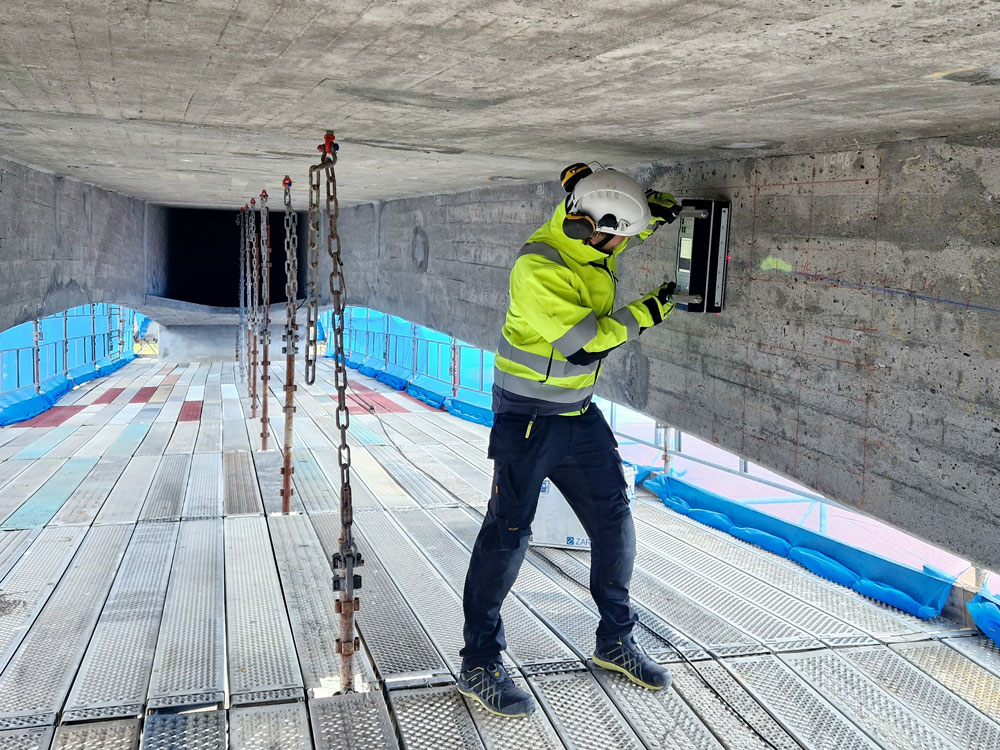
- Ground-penetrating radar (GPR) survey to map reinforcement and concrete cross-sections
- Material and Geometric Characterization
- structural analyses for evaluating crack initiation and load distribution
- design of reinforcement using carbon fiber fabric and carbon fiber rods
preparation of construction drawings and construction proposals
The reinforcement solution was based on horizontal reinforcement with carbon fiber fabric to limit crack propagation and improve the column’s confinement effect, combined with vertical carbon fiber rods to increase capacity and control cracking.
Equipment
- Proceq GP8000 – Ground-Penetrating Radar (GPR)
- Proceq DY-216 – Pull-off testing equipment for adhesion testing
Standards
- ISO 16311-2:2024 – Maintenance and Repair of Concrete Structures – Part 2: Assessment of Existing Concrete Structures
- SS-EN 1990 – Eurocode – Basic design rules for structural systems
- SS-EN 1991-1-1 – Loads on Structural Systems – General Loads – Dead Weight, Self-Weight, and Live Load for Buildings
- SS-EN 1992-1-1 – Design of Concrete Structures – General Rules and Rules for Buildings
- fib Bulletin 14 – Externally Bonded FRP Reinforcement for RC Structures
- Täljsten, B., Blanksvärd, T., & Sas, G. (2016) – Composite Reinforcement of Concrete, AB Svensk Byggtjänst
SS-EN 1504-9 – Products and systems for the protection and repair of concrete structures – General principles for the selection of products and systems