Problem statement
A load-bearing prestressed concrete column in an industrial building in Stockholm was severely damaged after being struck by a forklift. The damage resulted in extensive concrete spalling, through-cracking, permanent deformation, and failure of a large portion of the prestressing reinforcement. The column was part of the building’s primary load-bearing system and supported the roof structure via cantilevered concrete beams.
Due to the extent of the damage, the column’s load-bearing capacity was assessed to be significantly reduced, with a risk of further damage or collapse. The assignment therefore included an emergency damage assessment, the design of temporary shoring, and the development and evaluation of permanent remedial solutions to ensure the building could continue to be used safely.

Outcome
The investigation showed that the column could not be restored through localized repairs because a large portion of the prestressing reinforcement had lost its function. The original structural mechanism was therefore deemed to be irreversibly damaged.
Several permanent remediation options were analyzed and compared based on load-bearing capacity, feasibility, and impact on the existing building. After further investigation of the existing foundation using ground-penetrating radar, ultrasonic testing, and exposure of the reinforcement, a solution was selected that involved a new cast-in-place reinforced concrete foundation column combined with a steel column added on top. This solution enabled the safe and efficient replacement of the damaged structure with minimal disruption to existing operations.

Solution
Invator conducted an emergency condition assessment of the prestressed concrete column that had been struck by a vehicle and designed both temporary and permanent measures. The work included:
- Visual damage assessment and crack evaluation
- Assessment of deformations and damaged prestressing reinforcement
- Design of temporary shoring to relieve the load on the roof structure
- evaluation of alternative reinforcement and replacement solutions
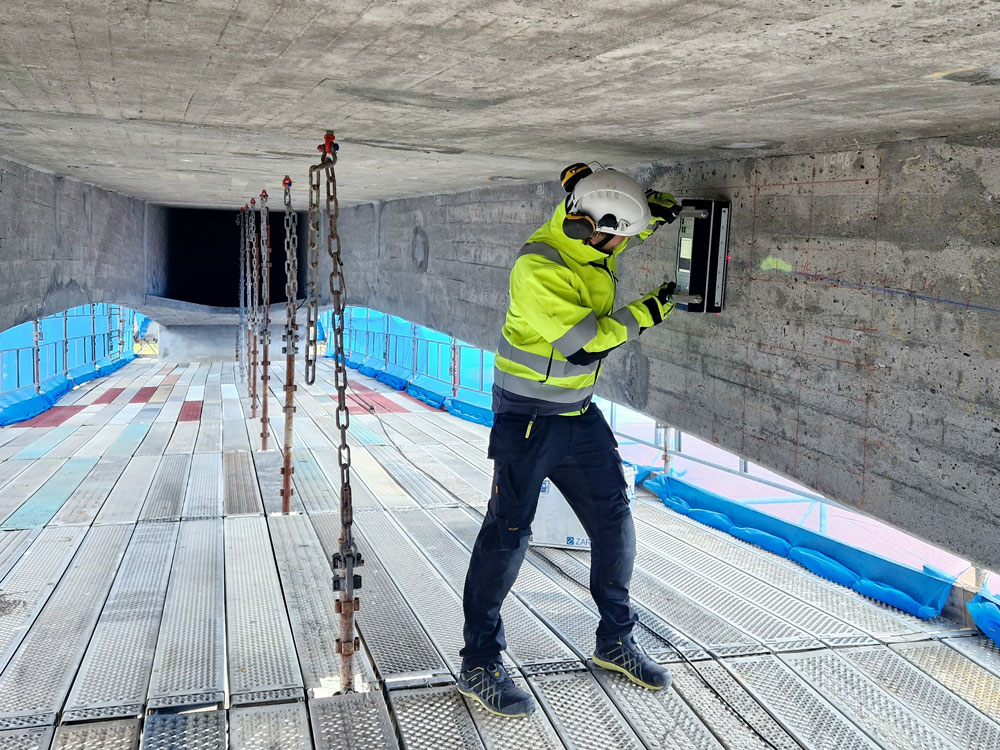
- Ground-penetrating radar (GPR) survey and ultrasonic testing of the existing foundation
- Exposure and verification of existing reinforcement
- Verification of the foundation’s bearing capacity and suitability for the new structure
- Development of a new permanent structural design and construction drawings
Following a technical evaluation, a solution was selected in which the damaged column was demolished and replaced with a new, cast-in-place reinforced concrete starter column anchored to the existing foundation.

Equipment
- Proceq GP8000 – Ground-Penetrating Radar (GPR)
- Pundit PL-200PE – Ultrasonic Pulse Echo (UPE)
Standards
- ISO 16311-2:2024 – Maintenance and Repair of Concrete Structures – Part 2: Assessment of Existing Concrete Structures
- SS-EN 1990 – Eurocode – Basic design rules for structural systems
- SS-EN 1991-1-1 – Loads on Structural Systems – General Loads – Dead Weight, Self-Weight, and Live Load for Buildings
- SS-EN 1992-1-1 – Design of Concrete Structures – General Rules and Rules for Buildings
- SS-EN 1993-1-1 – Eurocode 3: Design of steel structures – Part 1-1: General rules and rules for buildings
SS-EN 1504-9 – Products and systems for the protection and repair of concrete structures – General principles for the selection of products and systems