Problem
Quay 4 in the Port of Oxelösund, built in 1939, showed extensive corrosion damage in reinforced concrete, cracking in beams and piles and erosion in the tidal zone. Previous condition assessments indicated loss of cross-section in both concrete and reinforcement, delaminated cover layer and risk of reduced lateral stability. The assignment was to carry out a detailed condition assessment and install a Structural Health Monitoring (SHM) system to analyze the real behavior of the structure, compare with numerical modeling and provide a basis for future decisions on repair or strengthening.

Results
Visual inspections confirmed extensive corrosion, loss of cover and longitudinal cracks in beams and piles. Drill cores showed an average compressive strength of 49.6 MPa, exceeding the original design level (≈31 MPa). LVDT (displacement transducer) measurements showed small horizontal displacements (up to about 2 mm), which then stabilized. Strain gauges on piles recorded stresses mainly related to temperature variations (up to about 3 MPa). Accelerometers identified frequencies in several directions: with good theoretical agreement transversely, but clear reduction of stiffness longitudinally, which may indicate loss of global stiffness. Vertical measurements showed low stiffness under the crane girder, probably due to reinforcement corrosion and delaminated cover layer. In summary, loss of stiffness was observed in the longitudinal and vertical directions, while the transverse behavior was intact.


Solution
The condition assessment was carried out in several steps:
- Documentary studies and review of historical drawings and previous investigations.
- Visual inspection above and below water level, focusing on beams, slabs and piles.
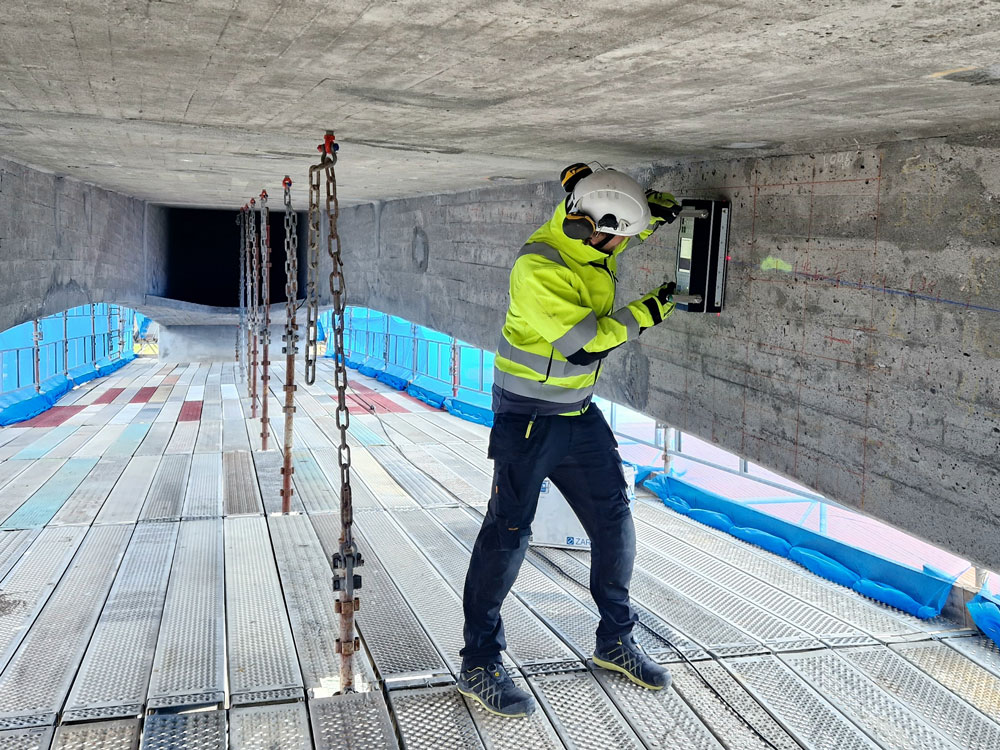
- Non-destructive testing: ground penetrating radar (GPR), ultrasonic (UPV), and boom knocking.
- Destructive testing: sampling of drill cores for compressive strength, density and thin section.
- Installation of SHM systems: LVDT displacement transducers, strain gauges on piles, accelerometers, temperature sensors and camera.
- Data analysis and comparison with numerical modeling in AxisVM to verify modal data and stiffness losses.
The methodology allowed for an integrated increased understanding of the current status of the structure and its dynamic behavior.
A day at work.
Equipment
- Georadar (Proceq GPR)
- Ultrasound (UPV, MIRA)
- Coating thickness gauges
- LVDT displacement transducers (specially designed for use in IP68
- Strain gauges mounted on piles
- Accelerometers (Type BDI)
- Temperature sensors (thermocouple)
- Camera for movement registration, in connection with ships docking at the quay
- AxisVM software for numerical modeling
Standards
- EN 1990: Eurocode – Basic design rules
- EN 1991-1-4: Eurocode 1 – Wind load
- EN 1991-1-5: Eurocode 1 – Thermal loads
- EN 1992-1-1: Eurocode 2 – Concrete structures
- SS-ISO 13822: Condition assessment of existing structures
- EN 12504-1 & 12504-4: Testing of concrete (drill cores, ultrasonic)
- EN 13791: Assessment of compressive strength
- ISO 16311-1/2: Condition assessment of concrete structures
- ASTM D6432-11: Guide for GPR