Problem statement
The Gisund Bridge, a concrete bridge built in 1972 with a total length of 1,147 meters, has post-tensioned cables in box girders. The purpose of the inspection was to evaluate the status of the grout in the box girders (PT-ducts) and to identify any voids or deficiencies that may increase the risk of corrosion in the cables. The effort was motivated by previous observations of cracking in the load-bearing parts of the bridge deck and suspected deviations from the original design documents.


Results
The investigations showed that several tensioning channels were insufficiently grouted. Conduit 31 in both the north and south beams was largely empty of grout, which means that grouting was missed during construction. Minor corrosion attacks on the tension cables could be noted but no significant cross-sectional reduction. Partially filled casings had a greater risk of corrosion than completely empty ones, due to moisture in the grout. Furthermore, longitudinal cracks were noted in the walls near axis 10, which were interpreted as cracks caused by transverse forces from the clamping forces. It is possible that these already occurred during tensioning. In conclusion, two out of eight casings in the examined span were found to be without grouting. Recommendations include further investigation, especially of spans with known design deviations.

Solution
The inspection was carried out in several stages:
- Review of drawings and previous documentation.
- On-site visual inspection and drone inspection of hard-to-reach areas.
- Locating reinforcement and cables with covermeter and GPR.
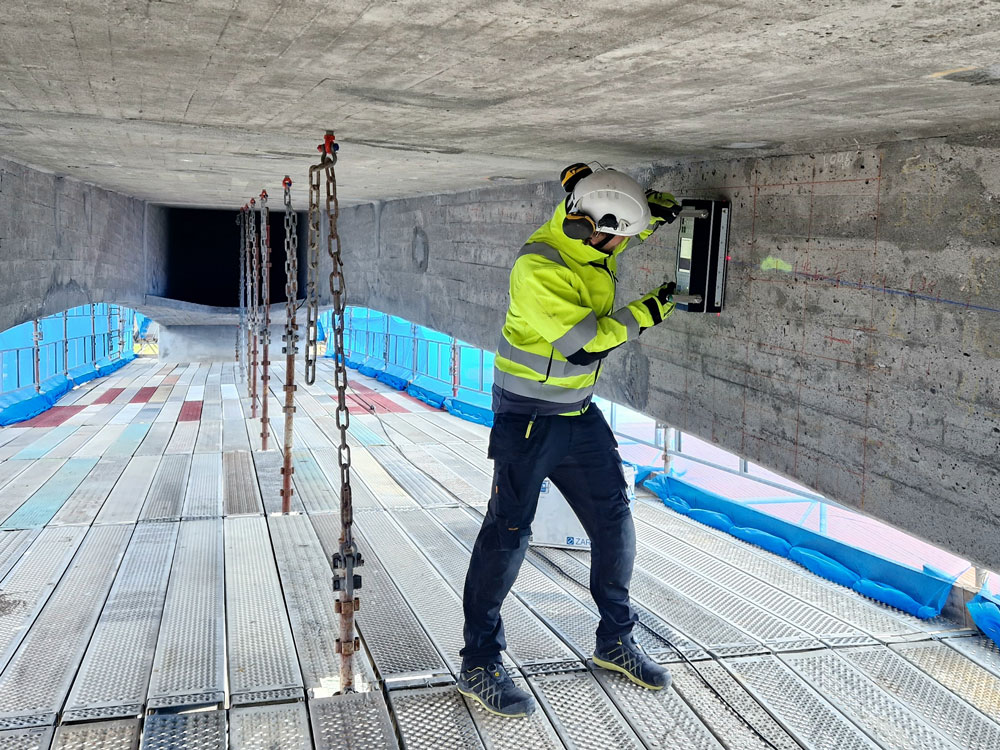
- Accurate mapping of the position and status of the cables with MIRA (ultrasound tomography), in total about 950 B-scans.
- Impact Echo (IE) verification, although the results were disturbed by ASR cracks.
- Core drilling and openings in both the north and south beams, 11 openings in total. These confirmed that ducts 31N and 31S were unused.
This combination of non-destructive and destructive testing allowed for a reliable mapping of the grout status and corrosion risk.
The next step is to develop appropriate repair methods.

Equipment
- Covermeter (Profoscope+)
- Ground Penetrating Radar (Proceq GP8000/GP8800)
- Ultrasound tomography (MIRA Tomographer)
- Impact Echo (DOCter)
- Drones (DJI Mavic 3 Pro)
- Videoscope
- Core drills and forming equipment
Standards
- EN 1990 – Eurocode: Basic design rules
- EN 1991-1-1 – Loads on structures
- SS-EN 1992-1-1 – Concrete structures
- ISO 16311-1/2 – Condition assessment of concrete structures
- Statens Vegvesen inspection manual (No. 718, 2021)