Problem
Alnöbron, located in Sundsvall, is a cantilever bridge in prestressed concrete completed in 1964. During previous condition surveys, signs of corrosion were detected in the tension cables and casing, especially in spans 6-8. Chloride levels of up to 6% were measured in the grout, which together with small cover layers (0-20 mm) indicated a significant risk of continued degradation.
The purpose of the assignment was to determine the condition of the tension reinforcement, assess the impact on the load-bearing capacity of the structure and provide recommendations for long-term sustainability. The project was conducted as a collaboration between Norconsult AB and Invator Sverige AB.

Solution
To enable an accurate condition assessment, a combined methodology was implemented using both non-destructive and destructive testing. The work began with an extensive drone inspection, carried out by Invator AB, where approximately 10,000 high-resolution images were taken and then compiled into a detailed 3D model. The model allowed for a comprehensive mapping of damage such as corrosion precipitation, cracking and splitting.
3D animation of Alnö bridge for effective external condition assessment (Video 2 min 47 sec).
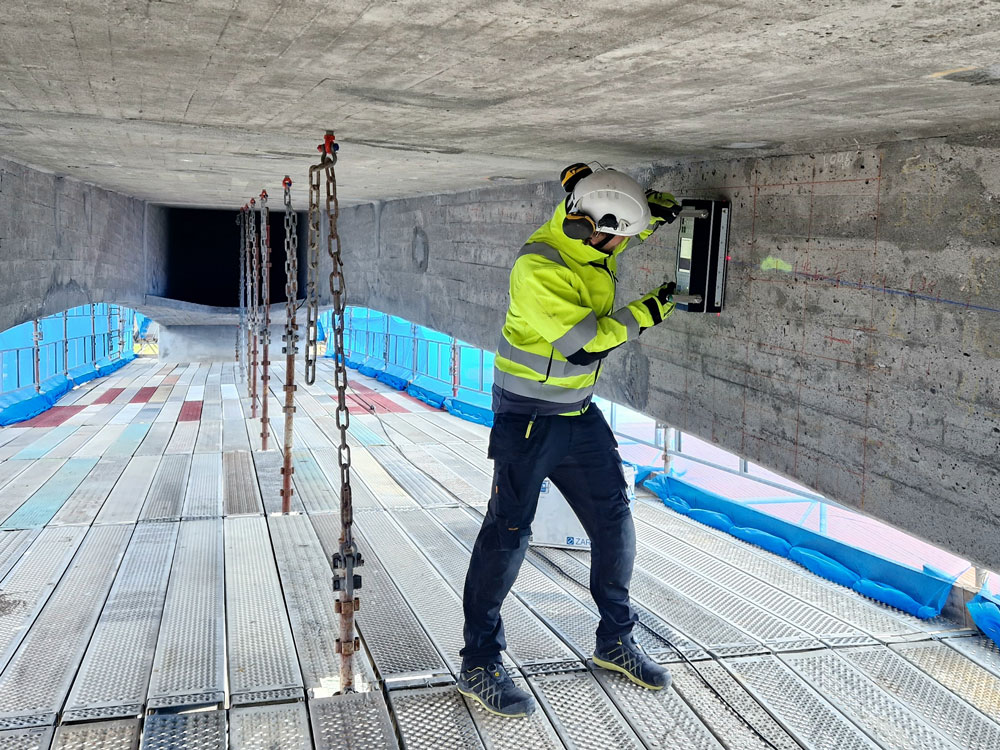
The fieldwork followed the methodology in Statens Vegvesen’s “Post-Tensioned Concrete Bridges – Inspection Manual 718”, adapted from Invators’ experience from similar projects. The inspection was carried out in several steps:
- Planning and mapping: Identification of critical sections and planning of measurement points based on previous damage observations.
- Location of tension rods: Georadar (GPR) was used to map the location, depth and cover of tension rods.
- Ultrasound tomography (MIRA): Performed to detect cavities and inadequate grouting in the feed tubes.
- Impact Echo (IE): Used as a verification method to identify delaminations and internal damage.
- Verification by core drill and videoscope:** Performed on selected points for visual assessment of corrosion status.
- After the surveys, opened areas were restored with adhesive slurry and high-performance repair mortar
The study also included recommendations for the re-injection of empty casings and the introduction of cathodic protection according to EN ISO 12696.

Results
The inspection showed that some tension rods had signs of corrosion and insufficient grouting but that the vast majority performed well.
The most vulnerable areas were found on the outside of the girder between supports 6-8, where the lining pipes were partially missing filling and corrosion damage was noted. The detailed 3D model provided a clear overview of the condition of the entire bridge and enabled an effective condition assessment of the exterior of the bridge.
The results of the condition assessment are the basis for recommended repair measures, where possibly re-injection and cathodic protection can be measures to restore and preserve the structure’s future corrosion protection. However, none of this has been performed at this time (winter 2025). The project contributed new knowledge on how advanced non-destructive testing and photogrammetric drone technology can be combined for a comprehensive assessment of prestressed concrete structures.
Equipment
- Georadar (GPR, Proceq) – localization of prestressing struts and cover layers
- Ultrasound tomography (MIRA) – mapping grouting deficiencies
- Impact Echo (Proceq) – verification of voids and delaminations
- Core drilling equipment – sampling and visual inspection
- Videoscope – internal inspection of casing
- Drones – photogrammetric collection and 3D modeling
- Coating and chloride analysis measuring instruments
Standards and references
- Norwegian Public Roads Administration Inspection Manual 718 – Methodology for post-tensioned concrete bridges
- EN 12696 – Cathodic protection of concrete reinforcement
- EN 446, 447, 934-4 – Grouting procedure and material requirements
- EN 1504-9 – Principles and methods for concrete repair
- AMA Civil Engineering 20 (BED.141) – Concrete cutting and repair work
- Swedish Transport Administration TRVINFRA-00213 – Inspection of bridges and bridge-like structures
Other
- The project was carried out in close collaboration between Invator AB, Norconsult AB and the Swedish Transport Administration.
- The effort helped to identify critical structural elements and establish a methodological basis for future maintenance strategies.
- Drone technology combined with non-destructive testing has proven to be a very effective method to minimize traffic impact while obtaining high data quality when inspecting complex concrete bridges.