Problem
The water tower in Söderhamn, built in 1971, had after 50 years of operation shown damage in the form of cracking, delamination and suspected defects in the tension cables’ anchorages. The client wanted a condition assessment focusing on mapping the location of the slack and tension reinforcement, the status of the anchorages, and the extent of carbonation and chloride levels. The aim was to provide a basis for repair and maintenance measures to ensure continued safe operation for at least the next 25 years.

Results
The inspection showed that the exterior had <5% surface damage, horizontal cracks with leaching and erosion damage probably linked to frost action. There was also corrosion in the mounting iron. On the inside, extensive delamination of a casting was noted in connection with the construction (about 40-50% of the surface) with water-filled voids between the casting and structural concrete. Non-destructive testing with GPR and ultrasound (MIRA) showed that the location of the reinforcement corresponded well with the drawings, but that anchors in zone 3 potentially showed defects, which were initially assumed to be due to delamination and possible deficiencies in the grease filling of the anchor cones. Chloride levels were low (<0.15%) and the depth of carbonation was moderate (20-25 mm), indicating that reinforcement corrosion is likely to be limited. In conclusion, the tower has localized damage that requires attention, but the global load-bearing capacity is intact. A second investigation, where anchors had been exposed, showed that there were no defects in the anchors themselves, but the signals obtained from the ultrasonic measurement were due to small voids in the concrete under the anchors themselves. Thus, only delamination of the casting needed to be addressed.

Solution
The project was implemented in the following steps:
- Visual inspection of inside (from ladder) and outside (by drone).
- Boom tapping to identify delamination.
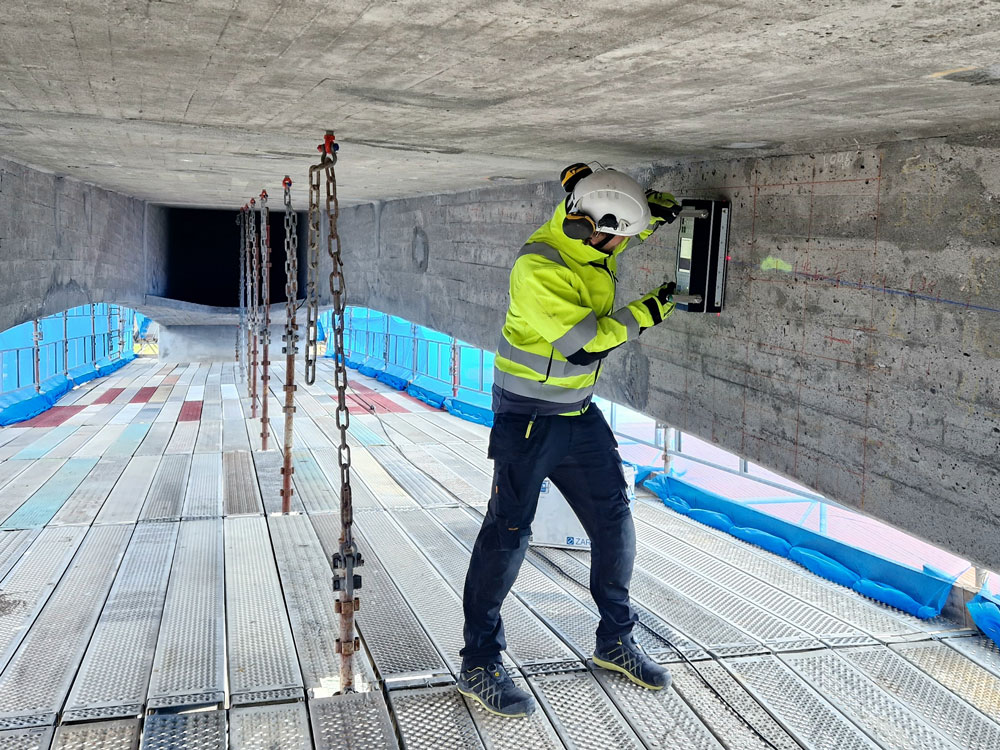
- Non-destructive testing with ground penetrating radar (GPR) and ultrasonic tomography (MIRA) for mapping of reinforcement and anchorages as well as voids and delamination.
- Coating measurements for reinforcement and tension cables.
- Sampling of concrete for chloride content and carbonation depth.
Recommended actions:
- Exterior: Remove loose concrete, anti-corrosive reinforcement, grout cracks, apply repair mortar and carbonation inhibiting paint system.
- Inside: Remove all coating, clean surfaces, apply new protective material or high-grade coating.

Equipment
- Drones (DJI Mavic 2 Pro + Canon EOS 6D Mark II)
- Ground Penetrating Radar (Proceq GPR)
- Ultrasound tomography (MIRA)
- Ultrasound (UPV)
- Impact Echo (IE)
- Coating thickness gauges
- Equipment for chloride and carbonation tests
Standards
- EN 1990: Eurocode – Basic rules
- EN 1991-1-1: Eurocode 1 – Loads on structures
- EN 1992-1-1: Eurocode 2 – Concrete structures
- EN 1504 series – Repair and protection of concrete
- ISO 16311-1/2 – Condition assessment of concrete structures
- SS-ISO 13822 – Assessment of existing structures