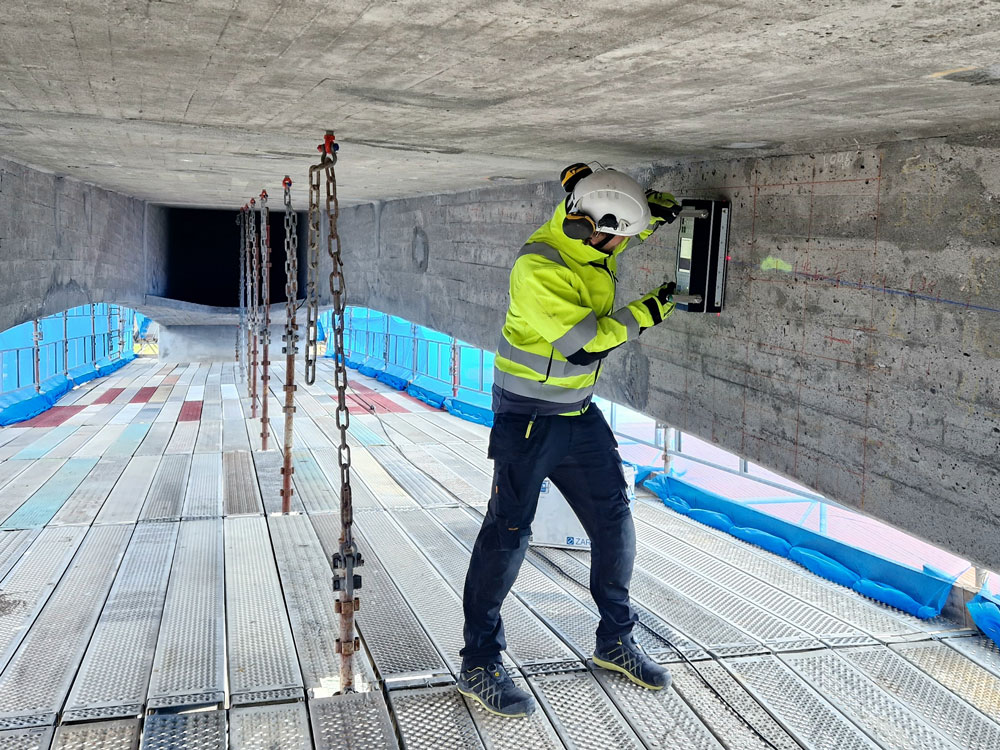
The Öland Bridge, built in the 1970s, has both slack reinforced and tension reinforced spans. The condition assessment focused on the span between supports 75 and 76, where corrosion damage to the slack reinforcement was previously observed. The aim was to map the status of the tendon cables, check for any voids in the casings and investigate the presence of chlorides that can cause corrosion in the tendon reinforcement.

Results
The investigation included GPR scanning, ultrasonic tomography, verification drilling and chloride sampling. A total of 15 tension cables were examined in the north and south beams. The results showed that no voids could be detected and that neither the casing nor the tendon reinforcement showed corrosion damage. Chloride levels in both the concrete closest to the casings and in the grout were low, which means that there is no risk of chloride-induced corrosion. The condition assessment thus provided a good basis for confirming the good condition of the tension cables.

Solution
The project was implemented in the following steps:
- Review of drawings and previous documentation.
- Visual inspection of beams and marked areas.
- Location of casing and reinforcement with GPR (georadar).
- Scanning with ultrasound tomography (MIRA) over excellent cables, in total about 300 scans.
- Verification by core drilling in three locations, with exposure of tension wires/cables and sampling of grout.
- Chloride analysis of concrete and grout.
- Drill hole logging
This methodology allowed for an accurate and reliable assessment of the status of the cables.

Equipment
- Georadar (Proceq GPR)
- Ultrasound tomography (MIRA)
- Coating thickness gauges
- Videoscope
- Core drills and forming equipment
- Standard equipment for visual inspection
Standards
- EN 1990: Eurocode – Basic rules
- EN 1992-1-1: Eurocode 2 – Concrete structures
- ISO 16311-1/2: Condition assessment of concrete structures
- Statens Vegvesen inspection manual (No. 718, 2021)