Problem statement
YARA’s approximately 90 meter high concrete chimney in Köping had two continuous vertical cracks, which ran from the top down to about 30-35 meters height. The chimney was built in 1963 with slack reinforced concrete and slipform casting. The damage raised concerns about the long-term load-bearing capacity of the structure, particularly as the horizontal reinforcement at the top was limited according to the drawings and inspection. The assignment was to carry out a comprehensive condition assessment to analyze the status of the chimney, clarify the causes of the cracking and propose repair and strengthening measures.

Outcome
The inspection by drone and crane documented two continuous vertical cracks and local repairs. Non-destructive testing (GPR and ultrasound) showed that the vertical cracks were continuous while horizontal cracks were superficial. Coatings measurement showed partially small coatings (10-15 mm) which contributed to reinforcement corrosion. Sampling (chlorides, carbonation, drill cores) was analyzed by RISE and showed carbonation depth of 6-12 mm, low chloride content (<0.4% of cement weight), and compressive strength 44-60 MPa and E-modulus 21-37 GPa. The concrete was assessed as moderate to good. Calculations (analytical and FE) showed that the cracks were probably caused by the combination of ovalization from wind and thermal gradients of 50-55 °C, combined with insufficient horizontal reinforcement in the upper parts. The damage confirms the calculations, which means that the structure is susceptible to further deformation and fatigue.


Solution
The condition assessment was carried out in several steps:
- Review of previous reports and drawings.
- Drone inspection of the entire outside of the chimney (south, north, east and west sides).
- Visual inspection from crane, with sampling of concrete for carbonation and chlorides.
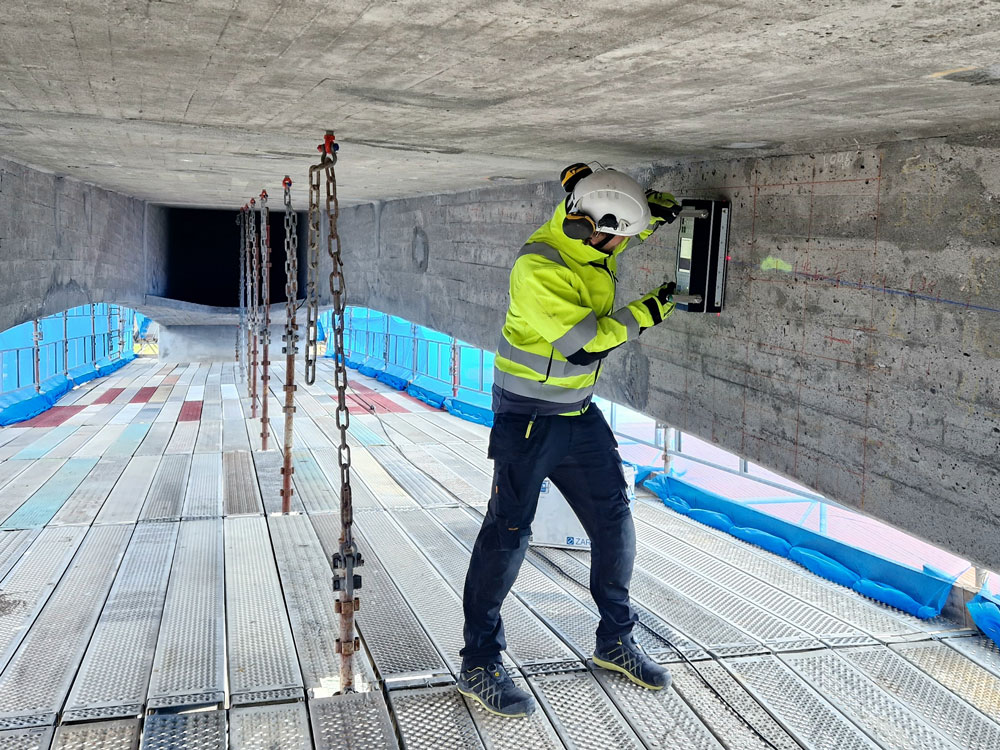
- Non-destructive testing with GPR for mapping reinforcement placement and cover layers, and ultrasound for crack depth.
- Sampling of 7 cores and laboratory analyses (thin section, chemical analysis, compressive strength, E-modulus) performed by RISE.
- Theoretical analysis according to Eurocode and ACI, complemented by FE modeling.
The analysis showed that the cracks were probably caused by thermal gradients and wind-induced ovalization, combined with a lack of horizontal reinforcement. Proposed measures included the installation of measuring equipment (crack width, temperature, natural frequency, peak deflection) and preliminary repair measures such as grouting of cracks and reinforcement with carbon fiber.

Equipment
- Drone (DJI Mavic 2 Pro) with 20 MP camera
- Mobile crane for access
- GPR (Proceq) for reinforcement mapping
- Ultrasound tomography (MIRA) for crack depth
- Coating thickness gauges
- Equipment for drill cores
- Laboratory equipment for strength testing, thinning and chemical analysis (RISE)
Standards
- EN 1990: Eurocode – Basic design rules
- EN 1991-1-4: Eurocode 1 – Wind load
- EN 1991-1-5: Eurocode 1 – Thermal loads
- EN 1992-1-1: Eurocode 2 – Concrete structures
- ISO 16311-1 and 16311-2 – Condition assessment of concrete structures
- ACI 224R and 224.1R – Causes, evaluation and repair of cracks
- ACI 307 – Design and Construction of Reinforced Concrete Chimneys
- EN 1504-9 – Repair and protection of concrete structures