Problem statement
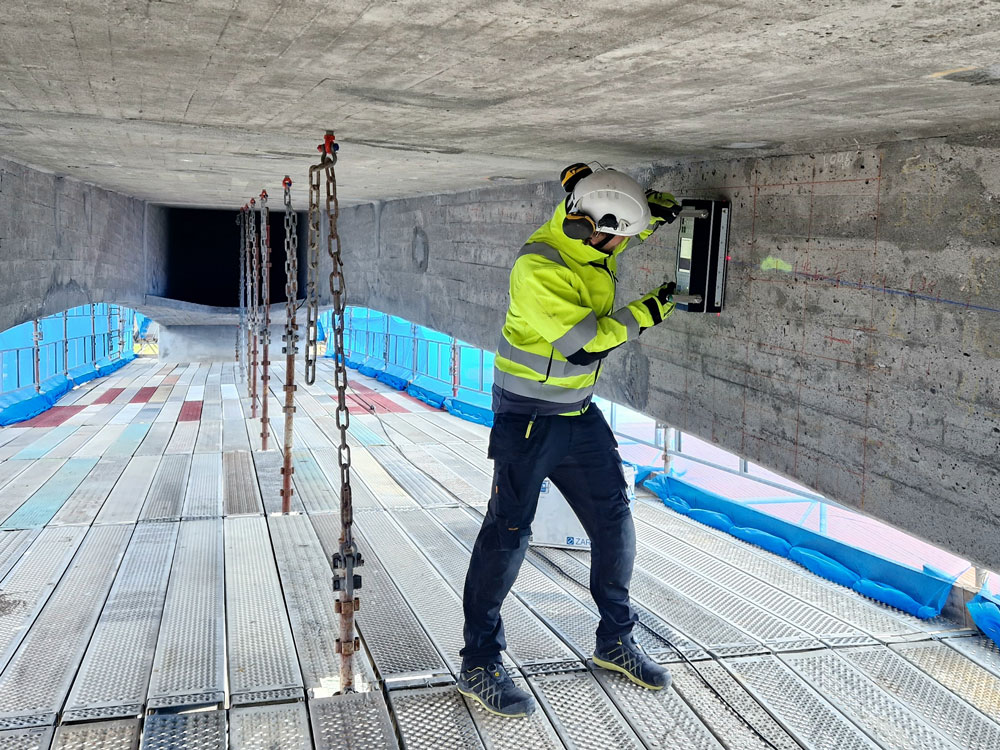
For Gimsöystraumen Bridge, an 840 m long concrete box girder bridge built in 1980, there were suspicions of incomplete grouting of the tension cable casings. The aim was to evaluate the status of the grout, identify possible voids in selected casings and map the risk of corrosion of the tension cables.

Results
The investigation showed that no serious defects could be detected in the opened canals. MIRA (ultrasound) and Impact Echo indicated suspicious areas in span 1, but verifying drilling and endoscopy showed that the channels were filled, with only moderate superficial corrosion on the metallic casings. However, minor deviations in the positions of the cables compared to drawings could be observed. In conclusion, the grout in the channels examined was found to be intact, with no risk of extensive corrosion.

Solution
The inspection was carried out in the following steps:
- Documentary studies and selection of critical control areas in consultation with the NPRA.
- Locating reinforcement and tension cables with covermeter and GPR.
- Detailed imaging of stress channels with MIRA (shearwave tomography), in total about 1500 B-scans.
- Confirmation of suspicious indications with Impact Echo (DOCter).
- Core drilling and endoscopy in selected areas for visual verification.
- The combination of non-destructive and verifying methods allowed for a confident assessment of the status of the grout.

Equipment
- Covermeter (Proceq Profoscope+)
- Ground Penetrating Radar (Proceq GP8000/8800)
- Ultrasound tomography (MIRA Tomographer)
- Impact Echo (DOCter)
- Videoscope
- Core drilling equipment
- Standard equipment for visual inspection and documentation
Standards
- EN 1990: Eurocode – Basic rules
- EN 1991-1-1: Eurocode 1 – Loads on structures
- EN 1992-1-1: Eurocode 2 – Concrete structures
- ISO 16311-1/2: Condition assessment of concrete structures
- Public Roads Administration Inspection Manual No. 718 (2021)