Problem statement
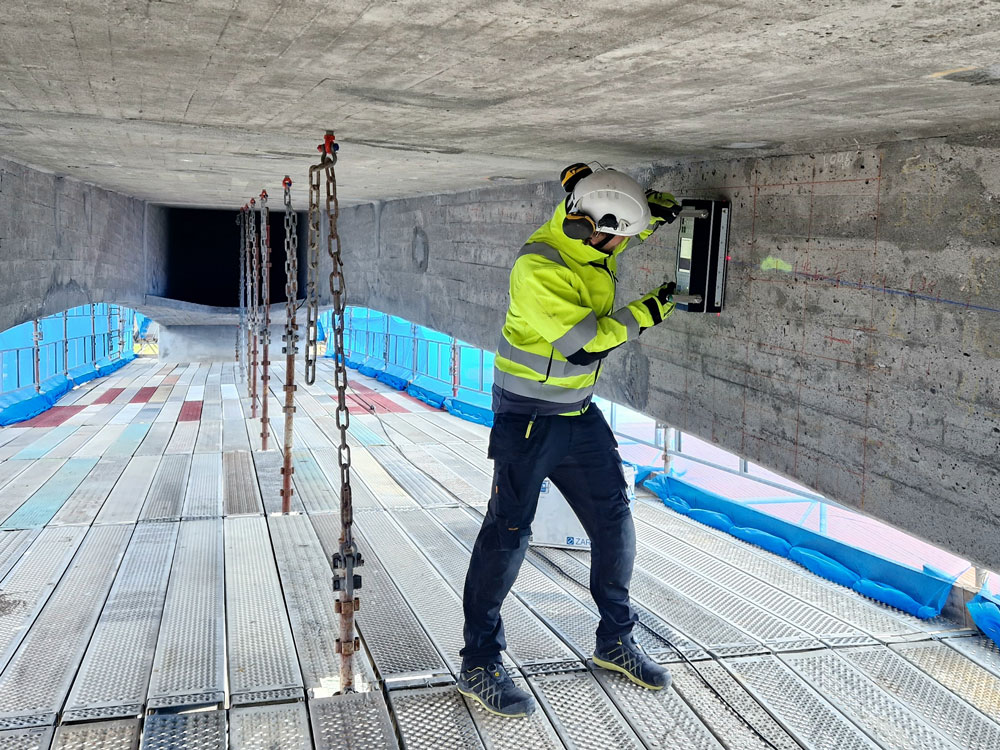
Many existing prestressed concrete bridges are approaching the end of their technical lifetime. Traditional inspection methods have shortcomings in accuracy and reliability, especially in the case of possible voids in the lining tubes, and it is also a major challenge to determine the residual tension of the prestressing reinforcement. The Kalix Bridge, 284 m long in 5 spans with the longest span of 94 m, was to be demolished and replaced with a new bridge, offered a unique opportunity to be used as a test bed to develop, test and calibrate modern methods of load testing, non-destructive testing (NDT) and digital twins. The aim was to identify the real load carrying capacity of bridges and create a basis for more sustainable management of infrastructure. The project was led by Luleå University of Technology and Invator was responsible for mapping the tendon reinforcement and casing. In this case, the tendon system was DYWIDAG.

Results
The project showed that the combination of load testing at the serviceability limit state, advanced instrumentation and various NDT methods provides a much better understanding of bridge capacity than traditional calculations and visual inspections alone. Several methods for determining residual stress were evaluated and compared against post-demolition verification tests. A digital twin of the bridge was developed to simulate future loads and climate impacts. AI-based methods for crack detection via UAV were successfully used. Finally, a methodology for the safe demolition of prestressed concrete bridges was developed, taking into account the Natura 2000 site where the bridge was located.
Invader’s part of mapping voids with non-destructive testing was successful and it turned out that there were several areas with voids and also areas with corroded DYWIDAG struts.

Solution
The work was carried out in three phases:
Field trials – Extensive load testing with convoy loading with trucks and dynamic tests. Bridge instrumentation included strain gauges, accelerometers, fiber optic sensors, inclinometers and thermocouples. Various NDT methods were applied: impact hammers, ultrasound, radar, tomography, etc. Invator was involved in this.
Analysis and modeling – Development and calibration of 3D FEM models and digital twin. AI-based crack analysis via UAV and laser scanning was implemented. Reliability and risk models were developed to support life extension and maintenance decisions. Luleå University of Technology has been the main responsible for this part. As well as for the final part comprising controlled demolition.

Equipment
- Load testing vehicles (heavy convoys)
- Strain gauges (Kyowa)
- Fiber optic sensors (LUNA ODiSI 6100)
- Accelerometers (PCB 393B31
- Inclinometers (A716-2)
- Thermocouple (type T)
- Optical measurement equipment (ARAMIS DIC)
- UAV with camera and laser scanner
- 3D FEM software (Abaqus, AxisVM)
- Digital twin simulation tools (RWIND, FLOW-3D)
Standards
- EN 1990: Eurocode – Basic rules
- EN 1991-2: Eurocode 1 – Traffic loads on bridges
- EN 1992-2: Eurocode 2 – Concrete bridges
- EN 1504 series – Repair and protection of concrete
- TDOK 2013:0267 – Swedish Transport Administration rules for test loading
- ISO 16311 – Condition assessment of concrete structures
- FIB Bulletin 80 – Proof loading of concrete bridges