Problem statement
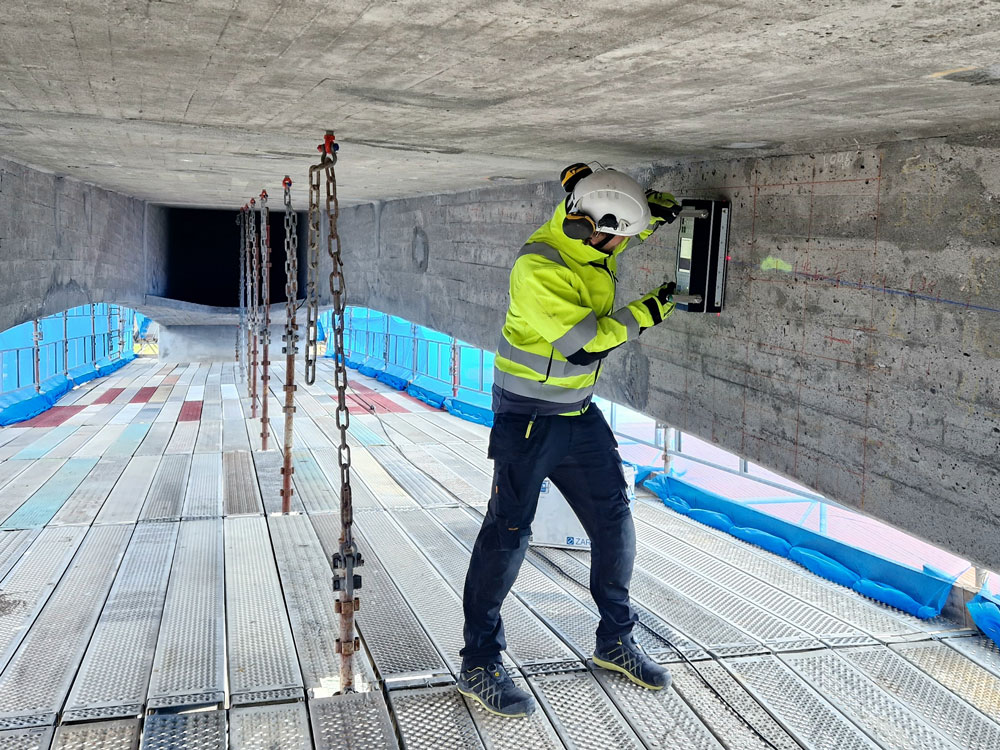
The railway bridge over Abiskojåkka, built in 1978 as a three-span box girder bridge, is an important part of the Ore Line between Kiruna and Narvik. Cracks in the webs (walls) had been observed in line with the tension cables and previous investigations pointed to potential problems with crack development. The aim of the project was to map the crack depth, determine the modulus of elasticity of the concrete and carry out a preliminary investigation of the cause of the cracking. In addition, a wireless measurement system was installed for long-term monitoring of cracks, strains and accelerations.

Results
The crack depth varied between 20-170 mm in the investigated sections. The modulus of elasticity of the concrete was measured to be about 41 GPa, corresponding to concrete class C50/60. Evaluation of the measurement data from the wireless system showed that cracks did not increase over time, indicating stable behavior. However, operational problems were noted with some transducers as well as large amount of data requiring more efficient handling. Examination of some casings by geo-radar (GPR) and ultrasound (MIRA) showed lack of grouting, however in the current environment external influence is minimal. The cause of cracking is considered to be partly due to the installation procedure during construction, but may also be due to forces from tensioning systems and insufficiently resisting slack reinforcement. In conclusion, the structure is stable but in need of improved data collection and in-depth investigations of the tensioning system.

Solution
The project was implemented in several stages:
- Verification of previous studies carried out
- Planning for the installation of metering systems
- Installation of wireless measurement system with crack sensors (LVDT), strain gauges, accelerometers and temperature sensors. Data was collected to cloud service.
- Non-destructive ultrasonic crack depth test (Proceq Pundit PL-200) according to standard BS 1881:203.
- The modulus of elasticity of concrete was determined by P- and S-wave measurements
- GPR (Proceq GP8000) and ultrasound tomography (MIRA) were used for the localization of feeding tubes and detection of possible cavities.
- Evaluation of data.
The methodology provided an overall picture of the bridge’s condition and proposals for further work were developed
Equipment
- Ultrasonic equipment (Proceq Pundit PL-200)
- Georadar (Proceq GP8000)
- Ultrasound tomography (MIRA Pulse Echo)
- Coating thickness gauge (Proceq Profoscope+)
- LVDT crack detector
- Strain gauges
- Accelerometers
- temperature sensors
- Wireless measurement system
Standards
- EN 1990: Eurocode – Basic rules
- EN 1991-2: Eurocode 1 – Traffic loads on bridges
- EN 1992-2: Eurocode 2 – Concrete bridges
- BS 1881:Part 203 – Determination of crack depth by ultrasound
- ISO 16311-1/2 – Condition assessment of concrete structures
- TDOK 2013:0267 – Swedish Transport Administration guidelines for testing and load tests